All blog posts ……..Start each work week with the latest issue. Scroll down to subscribe!
How to adapt (or design) instruction for older learners
In recent years, discrimination against individuals based on the group they belong to (vs. how they act as unique individuals) seems to have become less tolerated in corporate settings than it used to be.
That’s a wonderful improvement, but it doesn’t seem to have extended to all groups.
One notable exception in some technical training situations is so-called older adults. (So-called because “older” doesn’t actually have a specific meaning.) In some technical training situations, designers assume that all older adult learners:
- Are inexperienced with, or resistant to, “technology” (however that’s defined);
- Are bad at figuring things out, such as how to navigate an interface or troubleshoot download issues; and
- Prefer low-tech interfaces and processes over high-tech.
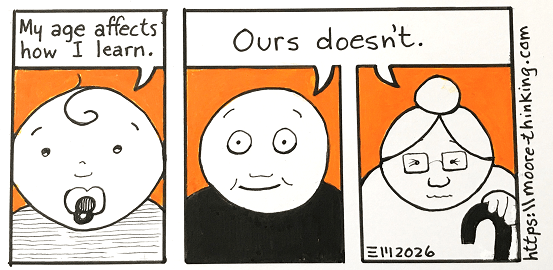
The truth is that the label “older adult learners” is neither meaningful nor useful.
But there is an approach we can take to support these learners—and that approach is described below.
Why the label “older adult learners” is meaningless and misleading
Characterizing a subset of the population as “older adult learners” isn’t useful because:
- It’s not accurate. Let’s assume we arbitrarily set a number of years after which we believe our adult audiences become “older adult audiences.” (30? 40? 50? 60?) Even if we do so, we’ll find that older audiences aren’t a monolithic group characterized by the same experiences, skills, beliefs, and attitudes. Some retirees, for example, may indeed be resistant to technology. Others may be retired from positions as coders, information architects, and usability experts.
- It’s not actionable. When we characterize a group of human beings as all being a certain way that they can’t help, we immediately frame the situation as one we can’t address or remediate. If we believe “older” learners behave a certain way because they’re old—and they’ll certainly continue to get older—there’s simply nothing we can do to tailor our instructional materials to meet their needs more effectively. Only when we understand that “older” learners behave the way they behave based on their skills, experiences, and preferences (and not because of their chronological age) can we begin to design to support and engage them.
How to design for “older adult” audiences
If we want to improve the effectiveness of our materials for any given audience, we need to identify the characteristics of that audience—and older adult audiences are no exception.
- Skills. The most important skills for online learning success are the ability to read; basic time management and study skills; familiarity with online conventions; and the ability to troubleshoot the inevitable technical difficulties. No matter what age our learners are, we use the same strategies to support them. For example, there are specific strategies we can use to support learners with low literacy and study skills, and making sure our materials are WCAG-compliant goes a long way to helping all learners navigate and consumer our materials easily.
- Attitudes/behaviors. Successful only learners are self-directed; proactive; willing to ask questions; and have patience with less-than-intuitive interfaces and inaccurate or incomplete processes. We can support tentative or impatient learners of all ages by providing a high-touch experience, an easily navigable interface, and well-designed online materials based on a sound scope and sequence telegraphed clearly through menus.
- Disabilities. It’s true that the incidence of sight, hearing, and mobility impairments tends to rise statistically as we age. But by no means are all older adults disabled—and by no means are all younger adults NOT disabled. We can support learners of all ages with physical impairments by ensuring our materials align with WCAG requirements.
The bottom line (TLDR)
Supporting older adult learners looks a lot like supporting all learners.
Applying sound design principles, testing a prototype on actual learners, and adjusting our materials based on learner feedback is a tried-and-true approach that will never get old!
What’s YOUR take?
Do you have a different point of view? Something to add? A request for an article on a different topic? Please considering sharing your thoughts, questions, or suggestions for future blog articles in the comment box below.
 Moore Thinking
Leave a comment