All blog posts ……..Start each work week with the latest issue. Scroll down to subscribe!
Good, cheap, or quick: Pick 2 (and only 2!)
Sometimes it seems as though we’re living in an increasingly impatient age, one in which we’re encouraged to believe that if we just purchase the right application or follow the right trends we can have it all, have it good, and have it quick. Simply wave the latest technological wand, we’re told, and instruction will develop itself! Or – better yet – learners will quickly and effortlessly teach themselves, with no need for us in the equation at all.
Of course, as the immortal words of P.T. Barnum remind us, if it sounds too good to be true it probably is.
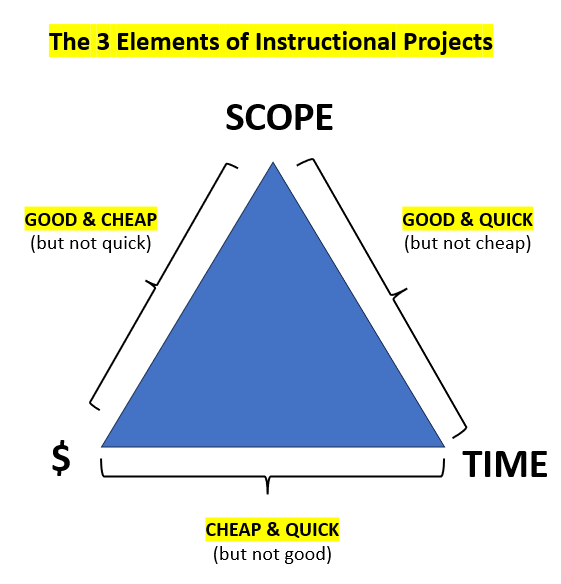
The fact is that the same three iron-clad constraints that apply to all real-world projects apply to instructional design projects: time, money, and scope. (In this context, scope refers not just to instruction length but to depth, complexity, accuracy, fitness for purpose, usability, and overall project quality.)
In this context, “scope” refers not just to instruction length but to depth, complexity, accuracy, fitness for purpose, usability, and overall project quality.
There are inverse relationships among these elements, which means we can produce training that’s quick, cheap, or comprehensive—but we can’t produce training that’s all three.
Below are some common choices and where they position our projects on the “iron triangle.”
1. Choices that lead to instruction that’s QUICK and GOOD (but expensive)
- Hiring highly competent staff and pulling in high-end contractors or even entire top-notch contract creative teams when necessary. The right team can compress timelines and deliver high-quality results by matching tasks with specialized skills, managing projects efficiently, and working long hours as necessary (all of which cost).
- Leveraging AI thoughtfully. For proprietary, high-risk training scenarios, AI is still quite costly. For all non-trivial training scenarios, accuracy and fitness for purpose still requires a team of highly trained (and, therefore, highly paid) experts to train and prompt the AI software and to vet and rework AI responses.
This approach is best suited for business-critical training projects.
2. Choices that lead to instruction that’s GOOD and CHEAP (but that takes a long time to deliver)
- Spending a lot of time sourcing free and low-cost materials and customizing them
- Taking our time and learning how to design and present information effectively as we go along
- Testing our instruction on unpaid cohorts (vs professional reviewers)
This is the default option for teams that lack formal in-house development expertise; that lack easy access to high-quality, pre-built instructional materials; and that have small budgets (such as some no-textbooks-allowed public school districts).
3. Choices that lead to instruction that’s QUICK and CHEAP (but that’s reduced in scope/quality)
- Cobbling together SME-produced materials
- Focusing on delivering and assessing knowledge (vs. focusing on actively scaffolding skills)
- Skipping or low-balling time-consuming tasks, even those that are required to drive meaningful learning outcomes (such as providing sufficient authentic skills assessments and post-training reference documentation)
This is the default option for teams that have a mix of skills and experience levels (in other words, teams with one or more members who lack professional-level design skills) and that also have easy access to pre-built materials (such as SME presentations and standard operating procedures).
The bottom line (TLDR)
It’s rare to begin an instructional design project with all the time, money, and unfettered access to top-quality talent and materials we’d like. This is the real world, and compromise is often the name of the game.
But compromise doesn’t have to translate into poor results.
Rather than pretending we can have it all and promising our stakeholders the moon (thus putting ourselves in the position of defending disappointing outcomes), we can take a clear-eyed look at what will need to be sacrificed—scope/quality, budget, or timeline—and then make decisions and set stakeholder expectations accordingly.
Doing so allows us to maximize the elements under our control and produce the most effective results possible.
And who knows? Over time, it might even lead to meaningful conversations about the value of quality training to the organization’s bottom line.
What’s YOUR take?
Do you have a different point of view? Something to add? A request for an article on a different topic? Please considering sharing your thoughts, questions, or suggestions for future blog articles in the comment box below.


Leave a comment