All blog posts ……..Start each work week with the latest issue. Scroll down to subscribe!
Workbooks assessments: what, why, & how
It can be hard to come up with meaningful ways to drive engagement and measure mastery—especially in corporate training situations.
One often-overlooked option is the workbook.
What’s a workbook?
A workbook is:
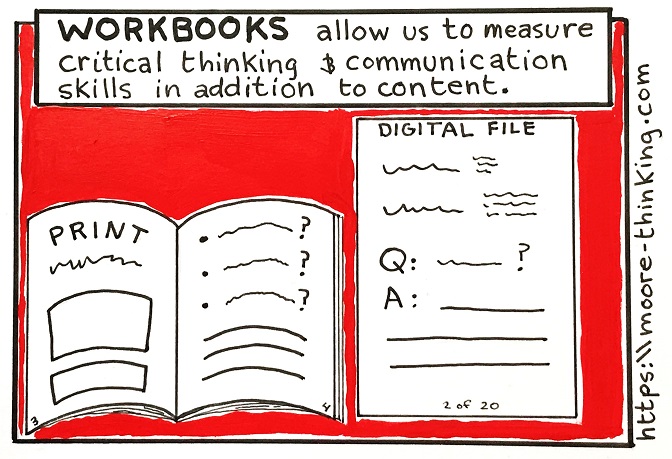
- A multi-page printed document or digital file that’s co-created by the instructor and each learner
- An interactive tool that promotes active learning, knowledge retention, and critical thinking
- A structured opportunity for trainers to gather rich, qualitative, actionable feedback from learners throughout the training process—feedback that can be rolled up into progress reports or dashboards for supervisor consumption
Workbooks typically include:
- A training schedule
- Training content
- Contacts and breadcrumbs learners can use to get supporting training-related information
- Blank sections learners can use to jot down notes, reminders, and questions
- Self-graded activities, including reflections
- Instructor-graded assessments
Workbook benefits
As a “one-stop shop” for all training-related material, a workbook can:
- Streamline the learner experience
- Provide a single place for learners to engage with training content and jot down notes and questions as they arise
- Enable learners to self-assess and track their own progress over the course of the training
- Provide instructors insight not only into learners’ knowledge and skills acquisition, but how well learners follow instructions, communicate, and approach problem-solving and skill-building
- Serve as a valuable, customized “take away” after training
Workbook drawbacks
Workbooks require:
- Significant instructor grading time
- Instructors who are able to grade subjectively without getting overwhelmed by details
- Active learner participation; if learners can’t keep up or refuse to participate, workbooks simply won’t be effective
Training situations that benefit most (and least) from workbooks
The training situations MOST appropriate for workbooks are characterized by at least a few of the following:
- Adult learners
- Complex tasks/skills involving multiple systems or processes that aren’t strictly transactional (the more nuanced and complex the skills to be trained, the more workbooks are useful)
- Training goals that authentically require learners to look things up, reason, and write things down (that is, communicate clearly) as part of performing a task or skill
- Environments in which on-the-job documentation is lacking or inadequate
- Volatile work environments that require learners, post-training, to identify and handle changed procedures quickly
- Training scenarios that require learners to develop “critical thinking” skills
The training situations LEAST appropriate for workbooks are characterized by:
- Training goals consisting of straightforward skills/tasks that rarely vary and don’t require much reasoning to perform
- Highly structured environments in which learners have access to high-quality documentation post-training
- Learners who struggle to read and write (or who resist reading and writing for other reasons)
Tips for creating effective workbooks
- Make your workbook relevant: you want it to be a working document that’s valuable both during and post-training.
- Make it easy to consume: learners should easily be able to identify what it’s for, how to navigate it, what to do, and when to do it.
- Make submitting workbooks for grading as easy for learners as possible, and make grading as easy for instructors as possible.
- Encourage instructors to grade workbooks between training sessions so that they can begin each session by addressing misunderstandings gleaned from learners’ workbooks and, if necessary, adapt their presentation on the fly.
- Encourage instructors not to get hung up on specifics when grading. The goal in workbook grading is to look for evidence that learners are grasping the most important info/concepts, gaps, and patterns.
The bottom line (TLDR)
Workbooks aren’t appropriate assessments for all training situations.
But they can be a terrific approach if you’re looking for an authentic, engaging activity that measures not just knowledge and skills acquisition but learners’ communication, self-motivation, self-reflection, and critical thinking skills as well.
What’s YOUR take?
Do you have a different point of view? Something to add? A request for an article on a different topic? Please considering sharing your thoughts, questions, or suggestions for future blog articles in the comment box below.


Leave a comment