All blog posts ……..Start each work week with the latest issue. Scroll down to subscribe!
The 4-stage, no-fail blueprint for skills training
As most instructional designers are aware, there are two basic categories of instruction:
- Instruction whose purpose is to drive the acquisition of knowledge, often referred to as “education.” Presenting the information we want learners to know post-instruction is the focus of this category. The purpose of any activities we assign learners—discussions, quizzes, essays—is to enable learners to demonstrate they understand facts and concepts. In other words, in education the focus is on knowing; doing plays a supportive role.
- Instruction whose purpose is to drive the acquisition of skills, typically referred to as “training.” Helping learners practice the skills we want them to be able to perform post-instruction is the focus of this category. The purpose of any information we provide learners—lecture, videos, interactivities, reference documentation—is to demonstrate, scaffold, assess, or support learners’ ability to create or perform. In other words, in training the focus is on doing; knowing plays a supportive role.
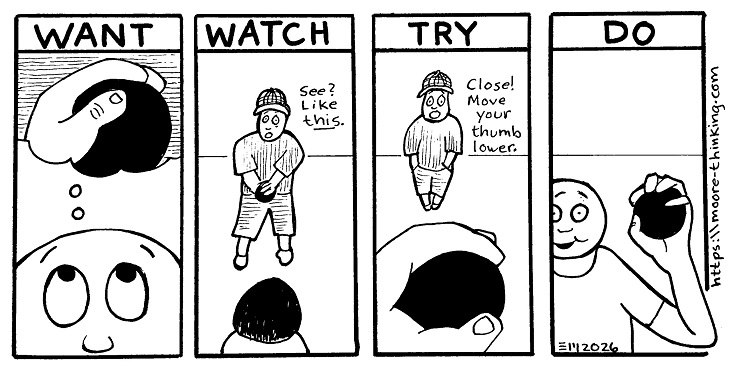
This article focuses on training—specifically, the four stages of skills acquisition. All learners, from toddlers to skilled adults, must go through each of the four stages below to acquire skills, from tying one’s shoes to acquiring business, technical, scientific, or any other skills.
And there are specific things we can do to support and assist learners at each stage.
Stage 1: WANT
Before any skills learning can take place, learners need to be motivated. They need to want to acquire, practice, and perform a new skill.
Sometimes, that motivation is intrinsic. For example, young children may be envious of older siblings who can tie their own shoes and therefore be self-motivated to tie their own, as a way of becoming independent and “grown up.” Autodidacts of any age decide (for whatever reason) they want to acquire a skill, and pursue it relentlessly until they’ve acquired it. Corporate learners may be motivated because they want to expand their skills, impress their bosses, or simply avoid being fired.
As IDs, writers, and trainers we can’t make the horses drink, so to speak. Ultimately, it’s up to learners to decide whether to embrace or resist training. But we can do our best to support learners in this stage by:
- Explaining to learners up front what’s in it for them. We may preface instruction by describing how learners can put the skills to practical use in their jobs or lives, or by describing the downside of failing to acquire and apply the skills (e.g., docked pay).
- Making instruction as clear, brief, and relevant as possible. This is key for all audiences, but especially for adult audiences.
Stage 2: WATCH
Before motivated learners can acquire skills, they need to discover how to perform those skills. They do this by observing and listening to others perform, or by reading or hearing about how to perform. Both observing performances and reading about how to perform are valuable.
For example, when we teach a child to tie his shoes, we instinctively stand next to the child and tie our own, slowly, to show how it’s done. We do this multiple times, and we also instinctively describe key points of the process, e.g. “Left over right, then right over and through.”
To support learners in this stage, we can:
- Provide multiple performance examples—in real time, if possible, so learners can ask questions; and face-to-face if possible for physical performances (so that learners can see all aspects of the performance).
- Provide glosses on all performance examples that point out steps done correctly, steps done poorly, and points in the performance that are the most critical.
- Provide any background or contextual information (such as definitions and explanations) necessary for learners to be able to understand the performance examples. For example, it does no good to demonstrate shoe tying to a child who isn’t old enough to differentiate left from right, or to present software navigation if learners don’t know what the software is called or where to access it.
- Provide self-serve examples and supporting information (in the form of illustrated text, annotated video, or both) that learners can access during and after viewing performance examples, as many times as necessary.
Stage 3: TRY
In this stage, learners perform skills in a supportive environment with encouragement, feedback, and reminders.
For example, a child typically needs to attempt to tie his own shoes many times before he gets it right; and it’s helpful to have an adult or sibling on hand to encourage, remind, point out, and assist if necessary as the child struggles, fails, improves, and finally masters the skill.
To support learners in this stage, we can:
- Require learners to perform skills in the context of realistic, meaningfully varied performance scenarios (e.g., different pairs of shoes).
- Break long performance sequences into shorter segments. After learners master the segments (formative assessments), we must ask them to string the segments together to perform the complete sequence (summative assessment). For example, we might encourage a child to perform the first step of shoe-tying several times until he’s comfortable with it before tackling the loops.
- Provide nuanced, real-time corrective feedback (and encouragement) to learners as they perform. Instructor/facilitator feedback is the gold standard; but rubric-aligned peer assessment and self-assessment opportunities are valuable, too, in different ways and for different reasons. Often, learners can self-assess physical skills (such as whether they successfully tied their shoes), But for conceptual or arbitrary skills such as writing a report or submitting an order using a specific system, learners need outside-of-themselves standards and correction.
- Encourage learners to “over” perform; that is, require them to practice the complete sequence many, many, times until their performance is fluent (and then practice some more).
High-quality post-training reference documentation is a requirement for the accurate performance of highly nuanced, critical, multi-step skills and skills that involve arbitrary systems or processes.
Emily Moore
Stage 4: DO
In this stage, learners perform skills on their own, in an authentic environment.
To support learners in this stage, we can provide easily accessible, high-quality documentation that learners can refer to at point of need for specific details. The need for reference documentation increases as the following increase:
- Skill complexity. In our shoe-tying example, obviously, no reference documentation is necessary; after a child has mastered the skill of tying his own shoes, he’s good to go. That’s because shoe-tying is a straightforward physical skill that doesn’t change over time, which is not the case with most skill trainings in healthcare, business, or manufacturing. The performance of highly nuanced skills, critical skills, and skills that involve multiple discrete tasks or steps requires reference documentation.
- Arbitrariness. Physical skills such as tying one’s shoes or riding a bike are subject to physical laws that—once understood—don’t change. Virtually all corporate training, however, is based not on unchanging laws but on arbitrary systems and processes that change rapidly over time for reasons not apparent to learners. The performance of skills that involve arbitrary systems or processes requires reference documentation.
The bottom line (TLDR)
The acquisition of skills requires all learners to progress through four predictable stages: want, watch, try, and do. Understanding these four stages can help us support learners effectively, no matter where they are in the learning journey.
What’s YOUR take?
Do you have a different point of view? Something to add? A request for an article on a different topic? Please considering sharing your thoughts, questions, or suggestions for future blog articles in the comment box below.


Leave a comment