All blog posts ……..Start each work week with the latest issue. Scroll down to subscribe!
Built to last: 9 tips for maintaining instruction
Occasionally, training is a one-and-done.
But more often, the instructional materials we create will need to be delivered to multiple cohorts over weeks, months, or even years. And that means updating our materials over time to reflect changes in our content and how it needs to be presented: for example, new logos, new corporate color palettes, and new legal requirements.
Maintaining instructional materials isn’t particularly glamorous, and it can take a chunk out of any staffing budget. Yet, delivering out-of-date instruction larded with incorrect details can do more harm than good by confusing learners, driving poor outcomes, and tarnishing our reputation.
The tips below can help make the necessary task of maintaining instructional materials as efficient and cost-effective as possible.
1. Design for maintenance.
- Build maintenance into your development plan to set expectations from the beginning. Doing so telegraphs the value of maintenance and allows you to plan and budget for necessary maintenance vs. expecting team members to get to it “when they’re not busy.” (They’ll always be busy.)
- Lean into text. Text is the cheapest, easiest form of deliverable to update. So if you know your maintenance budget will be tight going forward, build out as much of your content in the form of static text (vs. video or interactivities) as possible.
- Balance specificity and maintenance. The more specific materials are, the harder they are to maintain over time. But producing content that’s so general it doesn’t give our learners what they need to succeed doesn’t do anyone any favors. Instead, try to balance specificity with maintenance strategies such as voiceover narration that avoids mentioning volatile details (“Follow the breadcrumb that appears onscreen” vs. “Click some > placethat > willchange”) and using video fades to splice in replacement scenes.
- Make versioning consistent, and make it a priority. Stamp each deliverable clearly with a version number, publication date, or both (via footer on text and intro/outro on videos, interactives, and instructor guides). Doing so allows stakeholders to identify and discuss a specific version easily, which can save a significant amount of time and hassle.
2. Archive with maintenance in mind.
- Organize and label. Store published files in a flat folder structure that communicates file type and version quickly and accurately with the least clicks necessary, such as a project folder bearing a specific project name and version that contains sub-folders for images, videos, SME materials, design and development documents, sign-offs, source files, executable files, and SCORM files.
- Produce text versions of non-text materials. Generate and archive video transcripts, and either text or PDF versions of finished interactivities. Doing so allows your team to scan quickly for specific content that needs to be changed.
3. Take maintenance seriously.
- Plan. Plan a refresh cadence for each project as part of the post-implementation phase—such as annually, semi-annually, or timed to coincide with expected regulation or software version updates—and stick to it.
- Log. Create and maintain a project maintenance log that includes the project name; the date the project went live; who created it; the target audience; where both the source and executable files live; and when it will need to be refreshed.
- Assign. Assign project maintenance to specific team members, and treat versioning with the same rigor as you treat new project development.
The bottom line (TLDR)
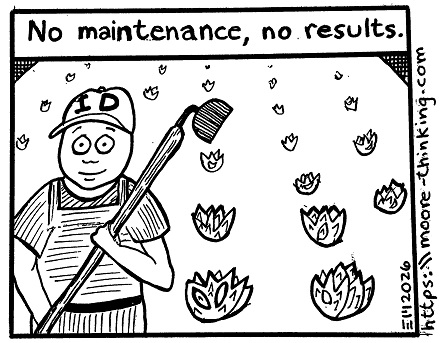
If creating instructional materials is like planting a garden, maintaining them is like weeding, pruning, and fertilizing: not as glamorous or as much fun as planning and building, perhaps, but absolutely necessary if we hope to harvest the fruits of our labor.
What’s YOUR take?
Do you have a different point of view? Something to add? A request for an article on a different topic? Please considering sharing your thoughts, questions, or suggestions for future blog articles in the comment box below.


Leave a comment