All blog posts ……..Start each work week with the latest issue. Scroll down to subscribe!
Content & assessments for conceptual topics
Q. What factor, more than any other, dictates the most effective way to design instruction?
A. Instructional content type. Note: If you answered “learning style,” please read this article.
What this means is that when we’re tasked with creating instruction around conceptual topics, the way we present our content, the activities we provide, and our assessment types should all look very different from the content presentation, ungraded activities, and graded assessments we would choose for, say, a visual or performance-based topic.
This article explains what effective conceptual instruction looks like—and why.
1. What is a conceptual topic?
A conceptual topic is any topic consisting primarily of ideas for which concrete, visual, one-to-one, real-world representations simply don’t exist. Examples of conceptual topics include security, freedom, government, comedy, and integrity. Unlike a non-conceptual topic (such as the human spleen, a specific website interface, or insects), a conceptual topic is theoretical. We may be able to find images that help us exemplify or explain a conceptual topic, but by definition there’s no single representative object we can use to communicate its complexity. In other words, there’s nothing we can point to in the real world that encompasses the totality of neap tides or music theory the way we can point to an actual human spleen, Amazon.com’s web interface, or a stick insect.
This might seem obvious—and perhaps it is. What’s not quite so obvious is the impact this has on instructional design.
Today’s trending short videos, interactivities, gamification, and learner self-discovery don’t work well for communicating conceptual topics.
2. Examples of conceptual topics in E&T
There are three main categories of conceptual topics in education and training.
- General. Some conceptual topics have no clear immediate application. Instead, their purpose is to inform learners’ world views and actions indirectly by helping them understand, relate, and recall a complex domain of information. History, philosophy, geography, social studies, literature, and business concepts—all classic education courses—fall into this category.
- Role-specific. Other conceptual topics provide the background and context necessary to perform a defined role in a corporate setting. Leadership, project management, and customer service are conceptual topics that fall into this category.
- Skills-specific. Still other conceptual topics provide the background and context necessary to complete a specific set of tasks, and so are often paired with skills training. Examples include a biology class (paired with a biology lab), printer theory (paired with hands-on practice servicing and maintaining printers), and soft skills (paired with hands-on practice providing customer service at a call center).
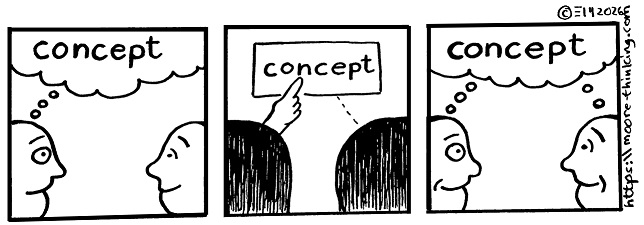
Concepts are specific, complex, nuanced thoughts, and words are the only way to communicate them.
3. Designing effective content for conceptual instruction
When designing content for conceptual instruction, keep these strategies in mind.
- Focus on words, words, and more words. Concepts are thoughts, and words are thoughts made visible. So the bulk of content for conceptual instruction needs to be presented in the form of words—text for learners to read and live lecture, video, and/or audio files for learners to listen to. Whatever format our words take, they should include definitions, descriptions, explanations, comparisons, analogies, stories, and examples.
- Don’t restrict yourself to text and lecture. Consider supplementing these proven approaches with live or video dialogs in which two people discuss or debate conceptual material. Most learners find a dialog between two people engaging to watch (which explains why entertainment talk shows and call-in podcasts are so popular). But in addition to audience appeal, the dialog format is uniquely useful in an instructional context. It supports not just the presentation of concepts, but a natural way to model concept acquisition. In a dialog, speakers can anticipate and proactively address misunderstandings; question or contradict a concept; point out inconsistencies; compare and contrast; clarify; and argue about a concept—all things learners need to do themselves to cement a concept in their minds—in a natural, conversational, compelling way.
- Choose visuals thoughtfully (and sparingly). Visuals can be of value in communicating some theoretical content; for example, a simple diagram can quickly explain the narrative arc of a novel in a literature class, or communicate how ink gets from an ink cartridge to the paper during the printing process as part of a printer maintenance training. But these diagrams are of supplemental value only, and need to be proceeded and described by explanations. Avoid “eye candy” visuals (visuals that don’t exemplify or drive the acquisition of critical instructional concepts).
- Show the human. Learners tend to respond more positively to the presentation of conceptual content by actual humans (vs. avatars or cartoons).
4. Designing effective activities and assessments for conceptual instruction
Choose a mix of group and individual work, if possible.
For group work, consider:
- Live lecture with participation, which allows learners to ask questions and debate easily.
- Small group discussions (in-person, synchronous virtual, or asynchronous discussion boards) to maximize learners’ ability to discuss, debate, clarify, defend, and persuade.
- Asking learners to explain a concept to a colleague, which requires learners to master conceptual material well enough to simplify and present it logically to a critical audience.
For individual work, consider asking learners to:
- Provide multiple real-life examples of a concept.
- Sketch a simple, visual representation of a concept such as a timeline or process flow.
- Respond to a “what if” scenario or word problem; that is, apply a concept to a hypothetical scenario and extrapolate the outcome.
- Write an essay explaining a concept and its relevance with respect to a given situation or group.
- Participate in a real-time interview in which the instructor asks learners to answer questions about a concept; defend statements made about a concept; or explain a concept extemporaneously.
The bottom line (TLDR)
Today’s trending short videos, interactivities, gamification, and learner self-discovery won’t work if our goal is to create effective instruction for a conceptual topic.
That’s because both communicating and measuring the acquisition of conceptual topics require us to focus on words, words, and more words in the form of lecture, texts, and meaningful person-to-person conversations.
What’s YOUR take?
Do you have a different point of view? Something to add? A request for an article on a different topic? Please considering sharing your thoughts, questions, or suggestions for future blog articles in the comment box below.


Leave a comment