All blog posts ……..Start each work week with the latest issue. Scroll down to subscribe!
Tips for creating compelling, effective assessments
An assessment is any graded activity we give learners to measure the extent to which they gained knowledge or skills from our instruction.
Assessments are the alpha and the omega—the beginning and ending, the goal and the outcome—of all instructional design.
- Assessments describe the change we want to see in learners, and so should be the first thing we define when we’re deciding whether or not to create instruction.
- Assessments determine what we should include in our instructional content, what we should leave out, and how we should sequence our content. (All content should support learners’ ability to successfully complete the assessments; and all content should be presented in a rational, step-wise order, building from basic to complex in a cumulative spiral.)
- Assessments enable us to measure the success of each individual learner, and to evaluate the success of our instruction overall.
The presence of assessments is what differentiates education and training materials from awareness and reference materials.
Not all IDs see assessments this way. Gathering content can become the focus, and some IDs view assessments as necessary afterthoughts—something to whip out quickly to finish a project.
But leaving assessments to the end of a project is problematic. It’s a bit like going to the grocery store with no meal plan in mind, coming home with a jumbled bag of groceries, and combining the ingredients. What we end up with won’t be intentional—and in all likelihood will result in a confusing, unappetizing mess. At today’s food prices, a sack full of wasted groceries is bad enough; but in the context of corporate learning, the wasted resources are much, much worse both in terms of staff hours and budget.
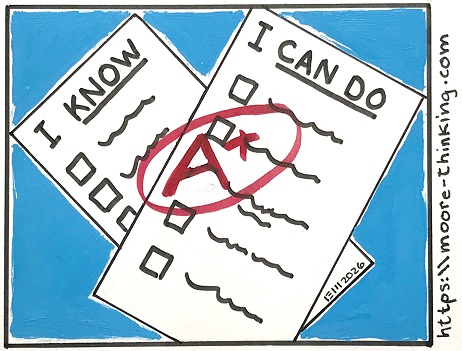
Fortunately, we can avoid unnecessary waste by designing both knowledge and skills assessments intentionally, from the beginning of an instructional project.
Knowledge Assessments
The goal of knowledge assessments is to measure learner knowledge of facts and concepts. Aim for a mix of the following assessment types.
1. Common knowledge assessment types loosely follow the competency continuum of Bloom’s verbs. They include true/false, multiple choice, multiple answer, drag-and-drop (grouping like things), ordering (sequencing steps or events), fill-in-the-blank, short answer, and essay.
2. Slightly less traditional individual knowledge assessment types include:
- Word search: useful for driving vocabulary acquisition.
- Explain to a peer in person or via video: useful for measuring learners’ ability to understand and prioritize the elements of a concept or process well enough to construct a logical, coherent explanation.
- Create a table: useful for measuring learners’ ability to compare and contrast multiple facts, concepts, objects, or processes based on multiple criteria.
- Fill in a Venn diagram: useful for measuring learners’ ability to compare/contrast attributes of two similar concepts.
- Label a diagram, illustration, or photo: useful only if labeling discrete parts of an image is a stated instructional goal.
- Draw an object or process: useful for measuring learners’ ability to recall and relate parts of a whole.
3. Group knowledge assessment ideas (gamification):
- Hangman: drives recall of vocabulary terms.
- Jeopardy: drives learners’ ability to identify and compare concepts/definitions.
- Basic quizzes with leader boards and badges: may appeal to some learners more than individual quizzes (and so be completed more often and with more enthusiasm).
Skills assessments
The goal of skills assessments is to measure learners’ ability either to create a work product, or to perform a task or skill. Example skill assessments include:
- Skill-related knowledge: Quiz learners on their ability to recall vocabulary terms related to the work product or performance.
- Skill-related knowledge: Quiz learners on their ability to recall and order the steps required to create a work product (or perform a task/skill) by assigning an ordering activity, flow chart, decision tree, or timeline.
- Skill-related knowledge: Quiz learners on their ability to explain and describe the purpose of each step required to create a work product (or perform a task or skill).
- Skill-related knowledge: Quiz learners on their ability to identify when a step has been completed successfully.
- Ask learners to compare, contrast, and critique worked examples (or video performances) using a review checklist or rubric.
- Ask learners to complete the first few steps of a work product, task, or skill; then the next few steps; then the final few steps (formative).
- Ask learners to critique each others’ formative assessments.
- Ask learners to create one or more complete work products (or perform a task or skill) from beginning to end (summative).
- Ask learners to create a work product collaboratively (aka “jigsaw”).
- Ask learners to perform a skill based on a mocked-up scenario or story problem.
- Ask learners to role play (either with each other, or individually with an expert).
The bottom line (TLDR)
Good instructional design begins and ends with high-quality assessments that align with instructional goals; that are supported effectively by instructional content; and that are designed to measure the appropriate level of competency and skills. When we fail to consider them early in the instructional process, we do our learners—and our organization—an expensive disservice.
What’s YOUR take?
Do you have a different point of view? Something to add? A request for an article on a different topic? Please considering sharing your thoughts, questions, or suggestions for future blog articles in the comment box below.


Leave a comment