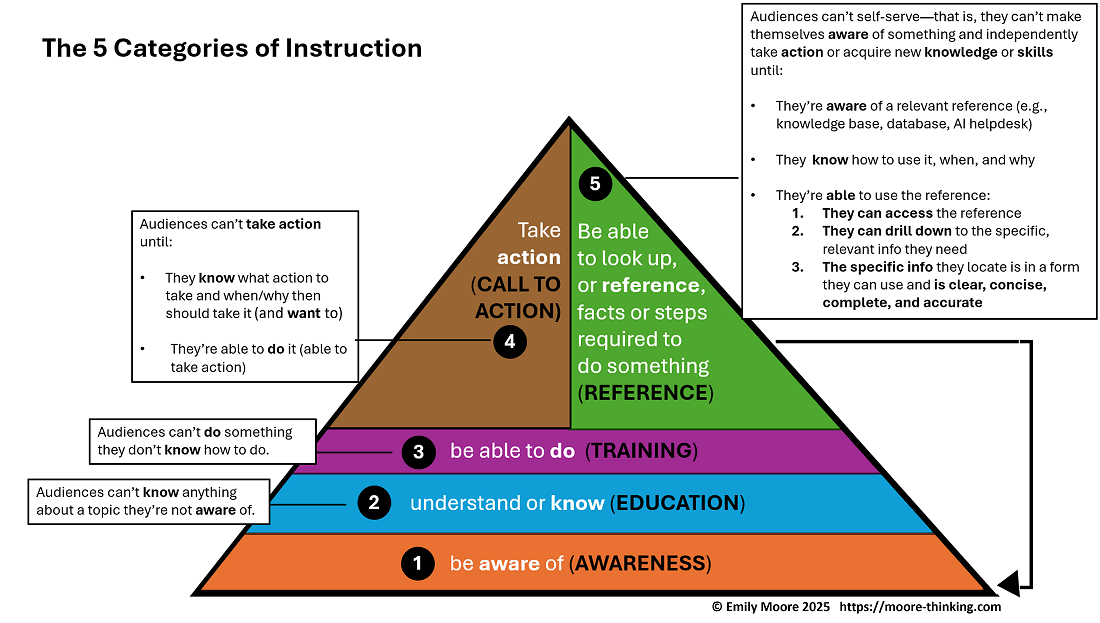
The first step in creating any effective communication is to identify which of the five possible categories our project fits into: education, training, awareness, reference, or call to action. Determining what category our current project fits into is important, because it determines which materials we need to create and how we should approach creating them.
A lot of us tend to want to skip this step. We “know” we need to create a training. Or perhaps our boss told us to put together a workshop or a presentation, and we never questioned whether that’s actually what would work best for our particular situation. Our tendency is to want to get something out there—to grab some sort of template and start creating materials immediately. The problem with that approach is that it leads to wasted time, wasted money, and poor outcomes.
The downside to jumping into a project before categorizing it
When we skip the categorization step, we:
- Create educational classes when we should have created trainings–and end up with audiences who still can’t do what we want them to do.
- Create trainings when we should have created either awareness projects, or a combination of awareness and reference projects–and end up with audiences who know they should be able to do something, but can’t remember how and can’t look up specifics because high-quality reference materials were never created or distributed.
- Create awareness projects when we should have created call-to-action projects–and end up wondering why our audiences aren’t taking the actions we assumed they would take.
- Create reference projects without accompanying awareness or training to go along with them–and end up wondering why our audiences don’t know about, can’t access, or can’t effectively use the reference materials we’ve provided.
- Create call-to-action projects that don’t give audiences the knowledge, ability, or incentive to take the action we want them to take–and end up wondering why our web site visitors don’t take the actions we wanted them to take.
To avoid making these common missteps, we need to understand the five basic categories of instruction: education, training, awareness, reference, and call-to-action.
The 5 categories of instruction
All “instructional” materials fall into one of the following categories, each of which I’ll be addressing in future blog posts.
- AWARENESS. An awareness project presents facts or concepts to an audience with no strings attached (that is, no accompanying assessment). If we want to present a message to audiences but do not plan to measure directly either their reaction to our message or any actions they may (or may not) take based on our message, our project is an awareness project. Examples of awareness projects include a memo or overcom announcement letting employees know the lunchroom will begin serving an hour earlier; a heads-up for an in-person community gardening presentation; a YouTube calligraphy tutorial video; an informational web site devoted to providing vegan resources; an in-person workshop on investment strategies; a poster announcing an upcoming concert; and an HR flyer describing an organization’s benefits enrollments period.
- EDUCATION. Education projects are concerned with knowing. If we want our audience to know facts or concepts after they complete our instructional materials that they didn’t know before, and we plan to measure their mastery of knowledge with answer key-based assessments in the form of quizzes or tests, we need to create educational materials. Examples of education projects include non-lab high school and college courses in Literature, History, Biology, or Philosophy; certification courses (such as financial planning); and mandatory assessed corporate e-learnings on topics such as sexual harassment and how to avoid phishing.
- TRAINING. Training is concerned primarily with doing, and secondarily with just enough “knowing” to be able to “do.” If we want our audience to be able to do something after they complete our instruction that they couldn’t do before, and we plan to measure their ability to perform a skill or task with a rubric-based assessment, we need to create training materials. Examples of training instruction include high school and college mathematics and lab courses (such as biology), corporate face-to-face trainings, cosmetology courses, heating and air conditioning training, English composition classes, speech classes, oil painting workshops, and computer programming courses.
- CALL TO ACTION. The goal of a call-to-action project is to get as many site visitors as possible to take a specific action, such as sign up for a volunteer committee, purchase a product, submit content to a website, or leave a comment on a blog. If we have a web site and plan to measure how many site visitors take action on our site and the quality of those actions (e.g., the dollar amount of each sale), we want to create call-to-action instruction. Examples of call-to-action projects include retail e-commerce sites, blogs that actively solicit comments, online dating sites, online job shops, online content aggregators, and web sites whose purpose is to drive volunteer sign-ups.
- REFERENCE. A reference project is a searchable collection of facts, documents, images, videos, and/or sound files designed to provide audiences a one-stop shop for looking up information at point of need. Reference projects come in two basic forms: a) a single document (such as a one-pager, printed book, or digital training manual), and b) the constructed output from a database (such as a component content management system) or ordered list that serves up multiple documents, images, videos, or sound files. Reference materials do not provide interactivity with any type of instructor, facilitator, or trainer, so audience access does not need to be scheduled or controlled. Reference projects don’t require a lot in the way of assessments, either, because the only ways to assess the effectiveness of a reference project is to analyze site statistics and to collect self-reported reactions from audiences with respect to quality and fitness of purpose. Reference projects are extremely useful for documenting numerous or lengthy processes on which audiences have already been trained (but which contain far too many arbitrary details for audiences to memorize). Examples of reference projects include a bird identification database that houses related images, descriptive text, and audio bird song files; a component content management system that constructs and serves up process documentation that describe the processes front-line employees must follow; a list of HR and tax forms posted on a company intranet; a printed thesaurus; and a technical support database of videos showing how to correct software error codes.
Advocating for categorization can be tough. But when project effectiveness must be maximized and costs minimized, it’s worth taking the time to explain the benefits of categorization to the project sponsor.
What’s YOUR opinion?
Have you ever been asked to develop a training when only facts, not skills, were involved? Conversely, have you ever been asked to put together a multiple-choice quiz to assess an audience’s ability to perform a task? How successful were these endeavors—and how did you measure your success? Please consider leaving a comment and sharing your hard-won experience with the learning community.
 Moore Thinking
Leave a comment