All blog posts ……..Start each work week with the latest issue. Scroll down to subscribe!
How to speak “SME”
As IDs, we communicate with stakeholders throughout the instructional design process. Our goal in each phase is to produce meaningful stakeholder-facing information that is as easy as possible for stakeholders to consume.
To do that, we need to speak the language our subject matter experts, or SMEs, speak in every phase of the design lifecycle: analysis, design, development, implementation, and evaluation.
1. Analysis
In the analysis phase, we gather requirements and present stakeholders with a statement of work for sign-off.
- Tip: Make sure the statement of work articulates project requirements, assumptions, risks, and details about the instructional deliverables your team is proposing.
2. Design
In the design phase, we ask stakeholders to review either a text draft (for text deliverables) or a text storyboard (for video or e-learning deliverables).
- Tip: Don’t be tempted to “jump the gun” and provide a fully designed document, a video, or a prototyped e-learning. The reason? When we do, we’ll hesitate to throw it out if it’s not what the stakeholder wanted and try to retrofit edits instead (which often leads to poor outcomes). In contrast, providing text for review makes change inexpensive and easy, which helps ensure that we develop the right things.
- Tip: Because it’s common for stakeholders to avoid reading drafts carefully, consider sending stakeholders your draft materials with the expectation that you’ll meet with them a few days later to discuss their reactions and feedback in person.
3. Development
In the development phase, we present stakeholders with a prototype for review.
- Tip: Expect this phase to take longer than you think it should. It’s not unusual for stakeholders who signed off a draft in the design phase to do a 180 in the development phase, now that the deliverables are starting to come to life and they can “see” it better. This doesn’t mean the design review was a waste of time! Careful consideration and re-thinking is a normal part of the process that helps your team deliver a stronger product.
- Tip: Use a review tool (like Articulate’s) if you have one; but also strongly consider getting together to meet with stakeholders and have them “kick the tires” while you take notes. This is a good way to capture nuanced reactions to the deliverable design and navigation flow that are tough to capture with a traditional review tool.
4. Implementation
In the implementation phase, we present stakeholders with proof the instruction is live and reports showing learner assessment scores.
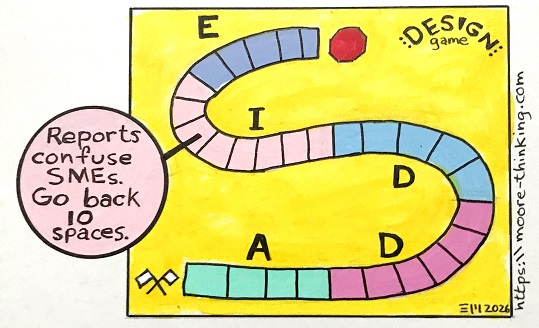
- Tip: Avoid complicated, overblown spreadsheets (whether generated by your LMS or developed in-house). The goal here is to present only the relevant information stakeholders need, and to present it in a way that makes understanding the implications and taking action easy. For quantitative assessments, a simple one-line report showing the overall percentage of passes (vs fails) is often sufficient. For qualitative assessments, a simple description in plain English for outliers only is typically the best approach: e.g., “Aaron struggles to master concepts and does not take advantage of self-study opportunities” for a low-achieving learner and “Betty consistently finishes tasks quickly and uses her spare time to help her colleagues” for a high-achieving learner).
5. Evaluation
In the evaluation phase, we meet with stakeholders to measure the extent to which the completed instruction solved an actual business need.
- Tip: It’s tempting to skip this step, reasoning that by this phase we’ve already done our job as IDs—training ordered, delivered, taken, done! In truth, of course, evaluation is the most important phase of all, so we even if we have to scale it back, we should never skip it.
- Tip: Evaluation requires qualitative communication; assessment scores are virtually never sufficient. Meet with stakeholders. Ask them to describe the behaviors they’re seeing in the field, correlate those observed results to training, and then go back to the appropriate phase of the design cycle and, as necessary, work through to the evaluation phase again, repeating as necessary.
The bottom line (TLDR)
As IDs, we tend to be pretty good at communicating specific messages to specific audiences. After all, that’s our job!
But it’s easy to get into the habit of equating “audience” with “learners.”
And while it’s true that learners are our primary and most obvious audience, for project success it’s just as critical that we pay attention to clarity, concision, relevance, and meaning when we communicate with our project stakeholders.
What’s YOUR take?
Do you have a different point of view? Something to add? A request for an article on a different topic? Please considering sharing your thoughts, questions, or suggestions for future blog articles in the comment box below.
 Moore Thinking
Leave a comment