All blog posts ……..Start each work week with the latest issue. Scroll down to subscribe!
The best content & assessment formats for your next ID project
One of the first questions we need to answer when we’re designing instruction is this: What form should our instructional content and assessments take? Video? Text? Interactivities? A mix?
How do we know?
The answer lies not in the latest trend or mythical “learning styles,” but in our instructional topic.
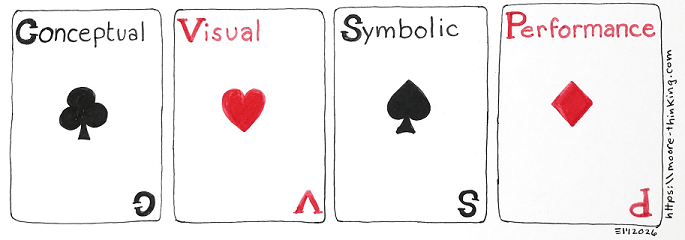
There are four basic types of instructional topics: conceptual, visual, symbolic, and performance. This article describes them all and lists the best content and assessment strategy for each.
#1: Conceptual topics
Conceptual topics are topics about ideas, facts, or concepts that aren’t easy to depict visually and so need to be communicated using words, words, and more words. Examples of conceptual topics include philosophy, literature, and leadership.
Best content format(s) for conceptual topics:
- Lectures, particularly synchronous lectures during which learners can ask clarifying questions
- Printed and digital text such as books and online articles
Best activities/assessments for conceptual topics:
- Discussions, real-time or via discussion board
- Assigned papers (e.g., essays) or presentations
#2: Visual topics
A visual topic is any topic that can’t be communicated in any meaningful way without using visuals. (Imagine trying to explain sfumato, chiaroscuro, how a 3D printer words, or the human respiratory system without using visuals!) Examples of visual topics include art history, business processes, and biology.
Best content format(s) for visual topics:
- Annotated images with callouts, captions, labels, and supporting text
- Videos with callouts, captions, labels, and supporting text
Best activities/assessments for visual topics:
- Labeling/explanation. Present an image (or video image sequence) and ask learners to label, describe, or explain it.
- Hotspots. Present a digital image overlaid with hotspots and ask learners to click to identify a specific subset of the image.
- Reconstruction from memory. Ask learners to draw an image or image sequence from memory.
#3: Symbolic topics
Symbolic topics are topics that require the translation of information from one symbolic language into another. Examples of symbolic topics include computer programming, math, tag language (such as HTML) construction, and foreign language instruction. Unlike other instructional topics, for symbolic topics a common text editor typically won’t work either to present content, or to gather it from learners.
Best content format(s) for symbolic topics:
- Flattened images showing symbols (such as programming code or a paragraph of French) along with handwritten callouts explaining important points.
- Audio files (for spoken language instruction) accompanied by text explanations.
Best activities/assessments for symbolic topics:
- Translation practice, whether that takes the form of speech, writing, or using a compiler or interpreter. Note that natural language writing activities are the most difficult of the options for both instructors and learners, because they require either a specialized editor (such as LaTeX for mathematics) or handwritten, scan-it-in assignments that must be assessed by a human being.
#4: Performance topics
Performance topics are topics designed to train learners either to create a work product, or to perform a task or skill. Examples of performance topics include software navigation, computer programming, presentation/speech making, and customer service skills.
Best content format(s) for performance topics:
- Worked examples, good and bad, each tied to a rubric and each accompanied by a gloss explaining the attributes that make each example good or bad (for work products such as worked-out match problems).
- Example video performances, good and bad, each tied to a rubric and each accompanied by a gloss explaining the attributes that make each example performance god or bad (for the performance of a task or skill, such as de-escalating a customer call).
Best activities/assessments for performance topics:
- Assigned work products, both part (formative) and whole (summative)
- Assigned performances, both part (formative) and whole (summative)
The bottom line (TLDR)
Categorizing our instructional topic into one or more of the four basic types—conceptual, visual, symbolic, or performance—saves us time and energy by enabling us to focus on designing and developing effective instructional content and assessments from the very beginning of the project life cycle.
What’s YOUR take?
Do you have a different point of view? Something to add? A request for an article on a different topic? Please considering sharing your thoughts, questions, or suggestions for future blog articles in the comment box below.
 Moore Thinking
Leave a comment