All blog posts ……..Start each work week with the latest issue. Scroll down to subscribe!
Why they’re not taking your training (and how to get them to)
Many of us in the instructional design business are so good at what we do that when we encounter lower-than-anticipated completion rates, we’re surprised.
Perhaps you’ve experienced the following:
- Learners aren’t signing up to take your course (or aren’t clicking to access the materials you spent so much time creating).
- Learners are starting your course, but bailing before they complete it.
- Learners are technically taking your course, but racing through it as fast as they can to get to the assessment, guess at the questions, and get the course marked complete. (In such cases, learner scores may be far lower than expected.)
- Learners required by their organization and role to complete your course are resisting, putting it off, or asking their managers if they can test out (or opt out altogether).
- Managers routinely create and deliver instruction to their teams on topics for which your department has already provided instruction.
Training that isn’t taken can’t possibly be effective. But why aren’t learners taking our training—and what can we do about it?
This article explains the three possibilities and offers strategies for addressing each.
If you’re in education, you may recognize these three possibilities as aligning with the cognitive, affective, and psychomotor domains (also known as head, heart, and hands).
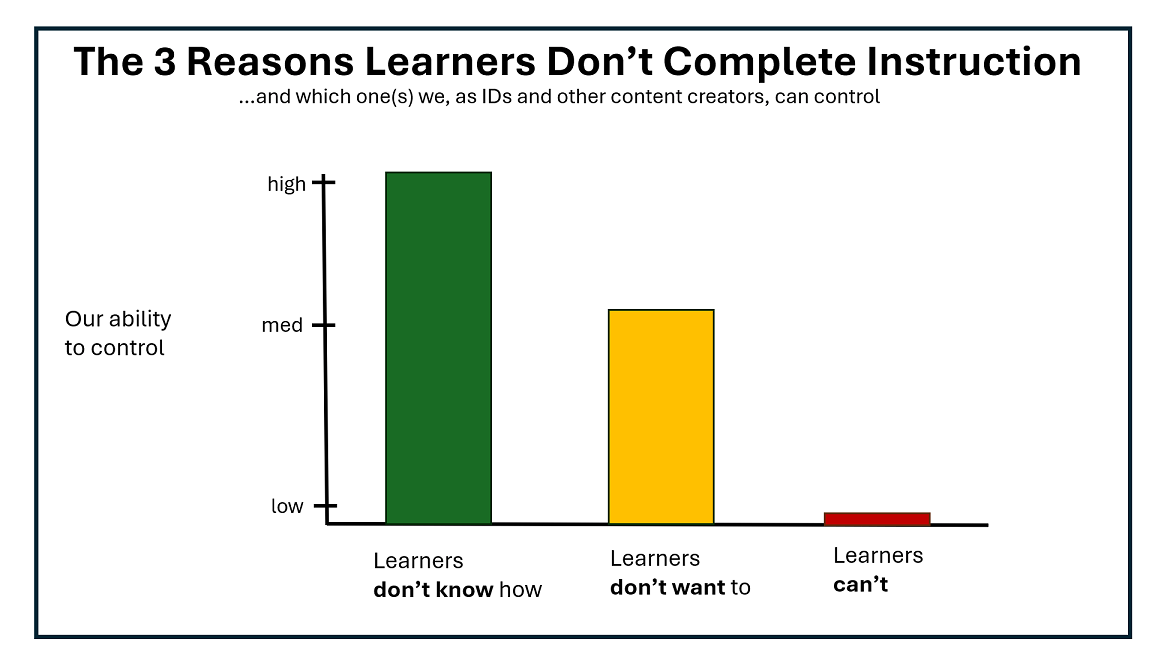
Reason #1: Learners don’t know how.
There are three points of failure associated with this type of resistance:
- Access. Learners don’t know how to find or log into our training. Some LMSs, for example, make discovering trainings a bit challenging. And if our materials are browser-dependent and our learners aren’t aware of it, they may not be able to access our materials.
- Drill-down. Learners can find our training, but once they do they don’t know how to navigate to the content they need.
- Use. Learners can find our training and navigate to the content they need, but when they do they can’t read it, understand it, or apply it.
We CAN fix this issue by following best practices around content creation and publishing, which include:
- Making our training discoverable.
- Providing a table of contents.
- Improving quality across the board: in other words, producing well-written text; relevant, annotated images; videos optimized for instruction; and engaging, nutritive, easy-to-use interactivities.
For more on this category of learner resistance, check out the ATD article Make it Easier for Online Learners, written by yours truly, Emily A. Moore.
Reason #2: Learners don’t want to.
Learners may know how to access, drill-down, and use our instruction, but deliberately choose not to for a variety of reasons ranging from personal to operational, such as:
- We’ve trained our learners to believe our instructional materials are a waste of time by providing low-quality materials (or materials perceived by our learners as low quality) in the past.
- Management directives or competing incentives are discouraging learners from completing our instruction.
- For whatever reason, learners don’t personally like the people or department who put the training together.
We MIGHT be able to fix this issue by increasing the quality, appeal, and engagement of our materials, or by advocating for increased incentives tied to training completion.
It’s important to note that, depending on the root cause, we may not be able to move the needle. (We can’t do much about competing incentives, for example, besides making management aware of the issue.) And sometimes, even identifying the root cause can be difficult.
Reason #3: Learners can’t.
Learners may know how to and want to complete our training, but be unable to do so due to:
- Lack of credentials. Learners can’t complete training if they don’t have access to all of the systems required to take the training’ for example, if they can’t log into the LMS that’s hosting the training.
- Lack of equipment (or any other physical requirement). Learners can’t complete training if they lack a working device, if their headphones are on the blink, or if they’re running a back-level operating system that isn’t compatible with our training.
Although we can bring the situation to the attention of the responsible parties and advocate for change, we CAN’T fix this issue ourselves.
The bottom line (TLDR)
When we don’t understand why learners aren’t completing instruction, we can waste time trying to fix something that isn’t broken. For example, we might spend a lot of effort trying to gamify instruction or boost engagement (in other words, addressing #2 – Learners don’t want to) when the real problem was our instructional content (#1 – Learners don’t know how to).
Only when we differentiate these 3 categories of learner resistance and identify which one(s) are affecting learner completion can we potentially fix the situation.
What’s YOUR take?
Do you have a different point of view? Something to add? A request for an article on a different topic? Please considering sharing your thoughts, questions, or suggestions for future blog articles in the comment box below.
 Moore Thinking
Leave a comment