All blog posts ……..Be sure to scroll down to subscribe!
How to apply Bloom’s verbs effectively
Bloom’s verbs refers to a list of verbs created post-WWII by educational psychologist Benjamin Bloom and a few other academics. The goal of the list was to quantify and articulate the progressive, cumulative stages of knowledge acquisition that take a learner from complete novice to expert in a given field, from “I remember X” to “I understand X well enough to apply X appropriately” and finally, potentially, to “I can analyze, evaluate, and even extend or replace the concept of X.”
Many versions of Bloom’s original list appear online, which can fuel a temptation to view specific verbs as much more critical than they really are. (Here’s one example list.) If we take these verbs too literally, however, we can actually defeat Bloom’s purpose in creating his famous list.
Read on to find out how to leverage Bloom’s verbs to drive learning outcomes.
How IDs, trainers, and educators can benefit from Bloom’s verbs
The purpose of Bloom’s list is to help us:
- Recognize the basic stages all learners go through to approach mastery;
- Build assessments that take those basic stages into account; and
- Administer the assessments we build in a more-or-less step-wise fashion to align with typical learning progression.
How to map verbs to assessment types
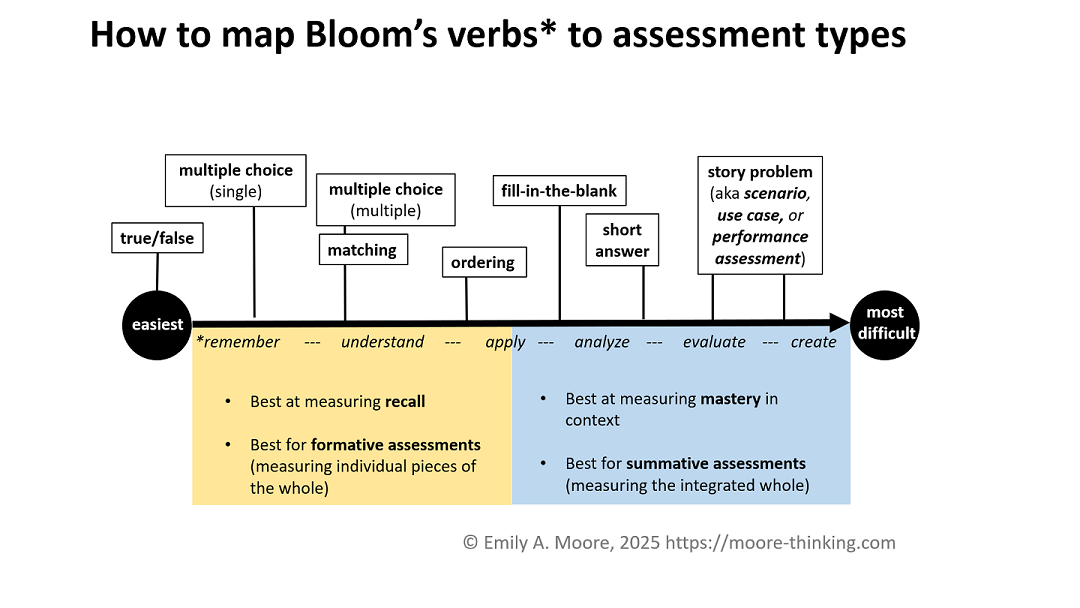
The types of knowledge assessments that most of us in education and training are familiar with map closely to Bloom’s verbs, as shown in the figure that appears at the top of this article. You can download your own copy of the figure here to have it handy:
The following familiar assessment types range from easiest (in general, best suited to learners at the beginning of instruction) to most challenging (in general, best suited to learners near the end of instruction).
- True/false questions are the easiest for learners to answer. At most, they require learners to recognize or identify a single true statement. At the least, all they require is a coin toss, which makes true/false questions valuable only in very specific situations.
- Multiple choice questions require learners to recognize or identify one true statement when accompanied by distractors, or untrue statements. Multiple choice questions offer a smaller chance of guessing correctly than is the case with true/false questions.
- Multiple answer and matching questions up the bar by requiring learners to recognize or identify multiple true statements and, for matching questions, to recognize or identify multiple fact pairs.
- Ordering questions require learners to recognize multiple events or steps and how each relates to the others.
- Fill-in-the-blank questions and Venn diagram completion activities require learners not just to recall or recognize information when it’s presented, but to differentiate that information based on recalled information.
- Short answer questions require learners to recall more complex, contextual information than fill-in-the-blank questions require. Short answer questions also provide a valuable window into how learners understand and think about facts and concepts.
- Story problems (aka scenarios, use cases, or performance assessments) can take the form of essays, authentic work products, or performance assessments and are the most challenging assessment type. This is where Bloom’s verbs shine – in providing us suggestions for creating authentic story problems and designing authentic work product and performance assessments that require learners to explain, apply, create, perform, troubleshoot, or adapt concepts in the context of real-world situations. Examples include asking learners to create an essay that includes an outline and analysis; to construct a diagram; to perform a process or demonstrate a skill; or to critique a process and propose an alternative.
The bottom line (TLDR)
Don’t overthink Bloom’s verbs! The value of these verbs is to get us thinking about how we might construct authentic assessments, not to get us obsessed with finding the perfect term.
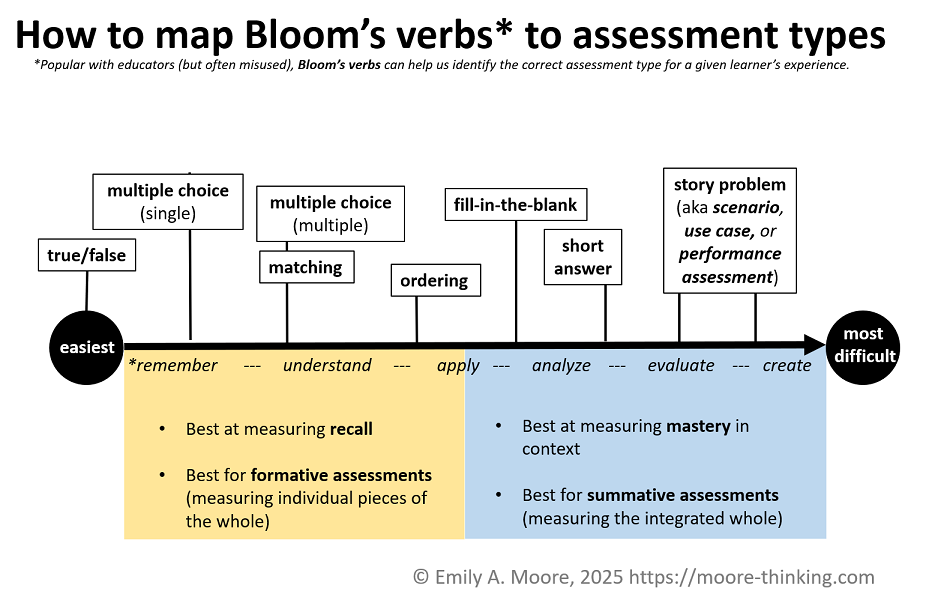
We’re far more likely to drive measurable learning by putting together a mix of well-constructed, easy-to-challenging assessments based on the question types shown in the downloadable image below than we are by getting wrapped up in any single verb.
What’s YOUR take?
Do you have a different point of view? Something to add? A request for an article on a different topic? Please considering sharing your thoughts, questions, or suggestions for future blog articles in the comment box below.
One response to “How to apply Bloom’s verbs effectively”
-
Interesting. I’d heard the term “Bloom’s Taxonomy” before but didn’t know what it meant. Thanks for the explanations.
Clay MooreJazz Guitarist. Louisville, KYhttps://claymoore.com
Supporting the arts means supporting artists–artists like the poet and fiction writer Devin Moore.
LikeLike

 Moore Thinking

Leave a comment