
All blog posts ……..Be sure to scroll down to subscribe!
As IDs, it can seem at times as though what we do is all that matters. That is, sometimes it can seem as though the instructional materials we create determine—and are sufficient, all by themselves, to drive—successful learning outcomes.
But while taking our work seriously is commendable, taking it too seriously can actually lead us astray if doing so encourages us to produce in isolation. Because the truth is, three components are necessary for any learning to take place—an instructor, a learner, and instructional materials—and all three must be integrated to be effective.
This article explains the three components and how they depend on each other; why designing effective instructional materials requires us to keep the other two components in mind from the very beginning of a project; why learners often refer to e-learning and even virtual instruction as “teaching themselves”; and how to overcome that perception.
Triad component #1: INSTRUCTOR
Knowing all the functions that an instructor performs and the different forms instructors can take is important because function and form affect not just the choice of instructor, but the choice of whether to include an instructor (such as in a formal education or training setting) or not (as in an awareness bulletin, reference materials, or a 100% asynchronous training course).
The functions of an instructor are to:
- Deliver information in a way that’s responsive and well paced.
- Emphasize what’s most important about the information being presented (e.g., by repetition and emphasis).
- Engage and motivate learners (for example, by calling on them in class as well as by incorporating their concerns and questions into ad hoc examples).
- Keep learners on track in terms of what needs to be done when.
- Adapt content presentation on the fly based on learner questions and perceived comprehension.
- Administer real-time assessments, both informal and formal, accompanied by as much nuanced, real-time feedback as possible.
Instructors can take multiple forms, both explicit and implicit.
- Explicit instructors include formal teachers, trainers, presenters, demonstrators, and masters (as in a master/apprentice scenario). Instructional designers create materials to support explicit instructors.
- Implicit instructors include models (as in a scenario where an expert performs a task and a learner models his or her own attempts on the expert’s performance) and life itself. Implicit instructors are useful to learners who cannot, for whatever reason, access explicit instructors. By definition, IDs have no role to play in implicit instruction.
Triad component #2: INSTRUCTIONAL MATERIALS
All IDs should be familiar with the function of instructional materials, which is to present information in a cohesive, structured way that enables learners to:
- Self-serve. Learners should be able to access, drill-down, and use the materials easily on their own.
- Consume the information they need in a content-aligned form. For example, information about visual topics should be presented to learners in the form of still images, video, or live action demo, while conceptual information should be presented in the form of text, live lecture, or video.
- Review. In addition to consuming materials from beginning to end, learners should be able to look up specific information within instructional materials quickly, efficiently, and reliably. This requires materials to have a table of contents in some form (supplemented by page numbers, links, or both) and to be easily searchable (for example, via Ctrl + “f”).
The forms instructional materials can take include:
- Text, with or without images, in the form of printable documents or web copy
- Videos
- Interactivities
- Instructor guides for live lectures or demos
- Assessments, ungraded (practice) or graded
Triad component #3: LEARNER
Learner capabilities vary for many reasons, as we’re all aware. But the ideal function of a learner is to:
- Show up to synchronous instruction on time and prepared to consume instruction.
- Access asynchronous instruction on time, ready and able to consume instruction.
- Consume the instruction in whatever form it’s presented, proactively backfilling as necessary.
- Engage with the instructor by asking and answering questions publicly (so that other learners can benefit from the answers).
- Engage with the instructional materials repeatedly and effectively (i.e., study effectively).
- Engage with fellow learners by asking and answering each other’s questions and assisting each other as appropriate.
Learners may be:
- Novice or expert in the subject area
- Struggling or proficient readers
- Weak or strong in terms of study skills (the ability to show up, access, and effectively consume materials)
- New to or fluent with the language in which the instruction is presented
- Unmotivated or motivated
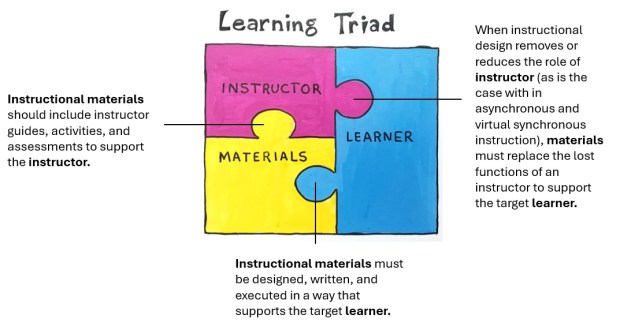
How triad component presence and quality affect learning outcomes
Because the functions of all three components must be present for learning to occur, when one or more components is weak or missing, the other component(s) must make up for that lack.
Specifically:
- Weak or absent instructors increase the burden on both the instructional materials and the learner to replace the functions of an instructor.
- Weak or absent instructional materials increase the burden both on the instructor to deliver equivalent information, and the learner either to take down all that information in note form, or acquire the information in a referenceable form in some other way.
- Weak learners require both the instructor and the instructional materials to be of the highest quality in terms of conciseness, clarity, completeness, organization, and support for learners’ lack of language fluency, engagement, motivation, and study skills.
The triad explains:
- Why teaching oneself is so difficult. Autodidacts must first seek out and put together their own materials, instructors, and community of fellow learners as best they can—which is difficult for someone who, by definition, doesn’t know what s/he doesn’t know and so can’t be sure what s/he is even looking for or how to gauge quality—and then interact with each of these components both proactively and effectively.
- Why learners of online instruction often refer to the experience as “teaching themselves.” Online instruction is often characterized by the limited, challenging, or nonexistent ability of learners to interact either with the instructor or each other—all of which makes the quality of instructional materials of critical importance. If those materials aren’t clear, concise, complete, and easy to locate, drill-down, and use—and if they don’t make staying on track (e.g., with a clear syllabus/schedule) explicit—learners are likely to fail.
- Why asking SMEs or teachers to create course content often results in poor learning outcomes. Producing effective instructional materials requires skills in content creation: skills in writing, sourcing and annotating images, sourcing and producing instructional video, producing engaging interactivities, and designing effective assessments. Most SMEs and teachers have a wealth of expertise and are terrific at their roles. But because most have not had formal training in content creation, the instructional materials they create are often less than effective; and that can put a burden on learners they can’t overcome.
Tips IDs can use to maximize the effectiveness of each component
- IDs affect the INSTRUCTOR by creating instructor guides, which are presentation decks complete with notes and suggestions for delivery and in-class activities and assessments. Instructor guides that are well designed and well executed free up instructors to focus on learner engagement and mastery. Poorly designed and executed instructor guides (e.g., cryptic, thrown-together PowerPoint presentations with no instructor notes) make the instructor’s job unnecessarily difficult and degrade the overall learner experience.
- IDs affect INSTRUCTIONAL MATERIALS through each of their design, development, execution, and delivery choices. IDs who know, for example, when to use text over video, synchronous over asynchronous delivery, and scenario vs. multiple choice tests for out-of-class assessments—and can execute their choices effectively—give learners the best chance to master instructions.
- IDs affect the LEARNER through the choice and quality of their materials. IDs need to identify learner characteristics before they begin a project and then keep those characteristics in mind as they design and create instructional materials. Common characteristics that materials need to support include those of novice and expert learners, struggling readers, international audiences, and learners who lack strong study skills.
The biggest miss
When e-learning began to reach critical mass a couple of decades or so ago, a popular phrase was “guide on the side vs. sage on the stage.”
Unfortunately, that goal is a lot harder to hit than most of us realized at the time. When we put face-to-face classes online and neglect to build into the online version the critical components that we reduced or removed when we moved that “sage on the stage” to a “guide on side,” we set up our learners for failure.
Moving instruction online requires us to recreate, in a virtual environment:
- The ability of learners to stay on track easily regarding what to do and when to do it
- The ability of learners to interact easily with the instructor and fellow learners
- The engagement and motivation of a face-to-instructor
- The ability for learners to ask questions of the instructor easily
- The ability for learners to interact with each other substantively and easily
- Real-time, nuanced assessment feedback
And, of course, if in moving to a virtual version of instruction we’ve removed a textbook and neglected to replace it with a resource of equivalent quality, we’ve made achieving a successful learning outcome even more difficult for learners.
The bottom line
To drive effective instruction, we can’t develop our “puzzle piece” in isolation. The instructional materials we develop must support both the instructors who will deliver it, and the learners who will consume it. This means we need to:
- Work with presenters/trainers to ensure the presentations and in-class activities we develop are accurate, solid, effective, align with any delivery constraints (such as time constraints or constraints associated with virtual delivery) and can be easily customized or expanded by presenters on the the fly. If our instruction will be delivered asynchronously (no instructor), we must attempt to incorporate as much of the engagement, explanations, examples, and nuanced, real-time feedback that a presenter would have delivered as we can into our asynchronous instructional materials.
- Identify the characteristics of our target audience and bake support for them into our instructional materials from the beginning. Are our learners likely be time-strapped and distracted? Will they likely struggle with motivation, reading, or study skills? Will they be a mixture of novice and expert learners where our subject is concerned? Often, our best bet is to err on the side of caution and make our instructional materials as effective as possible for a diverse audience.
The better fit we can create among the three components of learning—instructor, materials, and learner—the better chance we have of driving successful learning outcomes.
What’s YOUR take?
Do you work with instructors to create presentations, in-class activities, and other synchronous materials—or create them with specific instructors in mind? When you develop asynchronous materials, such as text, video, and interactivities, how do you identify your target audience and what strategies do you apply to tailor your materials for that audience? Please considering sharing your best tip (or worst frustration) in the comment box below.
 Moore Thinking
Leave a comment