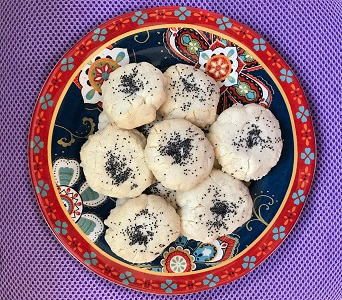
If you’re familiar with nan-e berenji, you know they’re disk-shaped, exotically spiced cookies a bit like Scottish shortbread—but made with rice flour instead of wheat flour and, traditionally, decorated with a distinctive stamped pattern and a sprinkling of poppy seeds.
But let’s say you’ve never tasted nan-e berenji or even seen them. How much instruction would you need to produce a successful batch?
Experienced home bakers wouldn’t need a lot of details beyond the ingredient list, suggested baking temperature and time, and number of cookies in a batch (which they’d use to determine how large to make each cookie, a calculation that affects baking time). People who know their way around an oven typically have experience with shortbread-type cookies, which are delicate and a bit hard to work with; and with rice flour, which tends to make doughs even harder to work with. These “expert learners” are familiar with rolling out, shaping, and stamping cookies using special stamps (for event-worthy cookies) as well as ordinary tools, like fork tines and their own thumbs. They know from experience that decorative toppings tend to roll off cookie tops and burn if they’re not placed in an indentation or “glued” onto the cookie surface with a bit of moisture, such as egg wash.
But for the sake of argument, let’s say you and I don’t know any of this.
We’re intelligent adults and we’ve logged a lot of hours over the years getting dinner on the table, but we don’t bake. We don’t even watch bake-off shows on TV, so we have no relevant experience. No matter how competent we are in other areas, in the context of cookie making we are “novice learners.” How might we novice learners interpret the following recipe instruction?
Using a spoon, make overlapping arch-shaped marks on the top of each cookie. Top each cookie with a sprinkling of poppy seeds.
Here’s what might go through our minds:
- How the heck do I make arch shapes in a cookie that falls apart when I barely touch it? Are the arches supposed to be super tiny? Or did I mess up the dough?
- Which part of the spoon should I use to make the marks? The handle tip? The front of the bowl? The back? The skinny side of the handle?
- How do I get the poppy seeds to stay on? Every time I sprinkle them on, they fall off!
- How will I know when I’ve done it right? Will the cookies still turn out okay if I make them into little blobs? Can I leave off the poppy seeds? Or will not following instructions precisely mess up the cookies’ texture or drastically affect their baking time?
We have these thoughts because there are multiple possible—and reasonable—ways to interpret the instructions provided, and as novice learners we have neither the experience nor the detailed instructions necessary for us to identify the correct interpretation.
Strategies to support novice learners
This example is obviously not mission critical; if learners’ cookies turn out a bit misshapen or overbrowned, the world’s not going to end.
But the principles are consistent across all training situations. To avoid confusion when creating materials for novice learners, as instructional designers we need to:
- Be specific. The text we provide our learners should be as clear, concise, and complete as possible. Including definitions and similes, spelling out acronyms, and numbering steps all help to remove ambiguity.
- Anticipate and proactively address potential questions and misunderstandings. Providing context-rich images and videos that supplement and extend the text by showing a process in action are both outstanding approaches—especially when the images and videos include thoughtful callouts and voiceover narration that point out easily missed conditions and potential areas of confusion. But even if we confine ourselves to text, we can think ahead to what we struggled with when we were learning the content (or what we’ve seen learners over the years struggle with). We can deliberately highlight these areas of potential confusion and proactively clarify them for audiences.
- Proactively set expectations around process. Let learners know how long a process should take and what the results of each step should look like; list options for alternative steps when appropriate; explain common errors and describe how to avoid or fix them. Perhaps most important, describe what learners can do to identify that they’ve followed a process successfully to completion—and how to recover if they’re unable to follow a process successfully.
- Provide structure in the form of a table of contents or menu. Instructional materials longer than a single page (or single screen) need to be organized in outline form. Whether it takes the form of a table of contents or a menu, an outline seamlessly communicates groupings and dependencies that are obvious to experts (but not obvious at all to novices). Outlines also support quick review, which is likely to be of high value to novice learners.
- If you’re presenting via virtual presentation or video, slow down. Presenters who are very familiar with a subject tend to race through content at a breathtaking pace that only other experts could hope to keep up with. But audiences who are not familiar with that subject need more time to process and store the information that’s new to them. Speak slower than you have to, pause more often that you think you need to, and make those pauses longer than you think you need to be.
Articulating small details that may seem obvious and even unimportant to seasoned experts is a lot of work. The more familiar we are with a topic, the more likely we are to miss the opportunities to scaffold novice learners and to undervalue those opportunities. (This is the reason SMEs tend to produce less effective instruction on their own than they do as part of a SME + ID team—seasoned IDs ask a lot of questions and insert necessary scaffolding, even when SMEs can’t understand why that’s necessary.)
The bottom line
There’s no downside to supporting novice learners; doing so helps expert learners, too, by filling in gaps in their knowledge and reinforcing concepts they already know. So if our goal is to support novice learners and create effective instruction, we need to incorporate as many of the strategies described in this article as possible.
That’s just the way the cookie crumbles.
What’s YOUR take?
Do you consciously apply strategies to support novice learners? If so, which strategies are you finding to be most successful? Please consider leaving a comment and sharing your hard-won experience with the learning community.
 Moore Thinking
Leave a comment