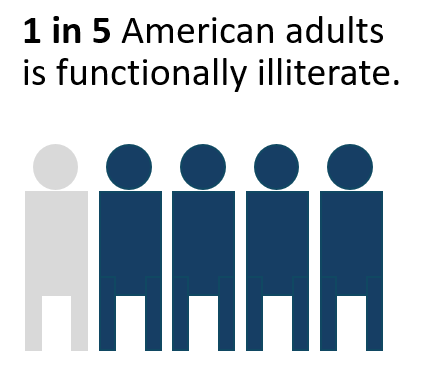
Bad news: Literacy rates in the U.S. aren’t great. Worse news: They appear to be on the decline. Currently:
- One in five Americans is functionally illiterate. Illiterate doesn’t just mean these individuals can’t curl up with a good novel on a cold winter’s evening. It means there’s a good chance they can’t accurately or confidently interpret job applications, government forms, contracts, assembly instructions, warnings, notes from their children’s teachers, or prescription labels. It means there’s a good chance they struggle daily to make enough money to survive and to keep themselves and their families safe and healthy.
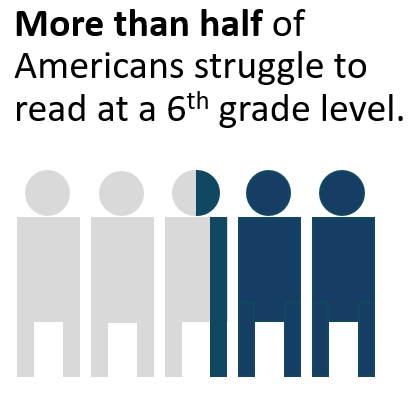
- Fewer than half of all American adults are capable of reading at a sixth-grade level. And sixth grade texts, you may be as startled to discover as I was, are too simplified to communicate complex, nuanced ideas or do much in the way of driving connections or mastery. (Judge for yourself: here are some representative examples of what educators consider text written a sixth grade reading level.)
- Literacy underpins numeracy and problem-solving skills—both of which are lower in the U.S. than in many countries and both of which appear to be declining. Being able to read isn’t separate from being able to do basic math or figure stuff out; being able to read is a primary driver and enabler of math and problem-solving skills. So when literacy levels fall, so do math and problem-solving competencies. Echoing the gap between rich and poor Americans, the gap between Americans who exhibit high and low levels of numeracy and problem-solving skills is widening.
- The latest figures suggest that only about 1 out of 3 American fourth graders is able to read at a “proficient” level, as defined by educators. The fourth grade milestone is of special interest because it’s prophetic: research shows that children who struggle with reading at this stage are unlikely to become fluent readers as adults.
These stats are worse than you might think, because “proficient” may not mean what you think it means. Educators’ interpretation of the word certainly doesn’t align with mine—or with the reading proficiency standards in place a few generations ago, as evidenced by the McGuffey’s Eclectic Readers series commonly used in American lower grades in the late 1800s/early 1900s.
How can we help?
If we provide instruction in any form—education, training, awareness, reference, or call-to-action—our job is twofold: 1) to be aware that a significant percentage of our audience may struggle to read, and 2) to do all we can to help them.
Here’s how.
- Deliver instruction face-to-face if at all possible (not online). I say this fully aware that the internet exists. A perceptive teacher sharing the same physical space with struggling audiences can identify deficits readily and provide customized remedial assistance on the spot. The technology-related and class management overhead associated with delivering instruction online, in contrast, makes identifying struggling students and providing appropriate support and assistance much more difficult.
- If face-to-face instruction isn’t possible, in your online instruction provide more spoken-word materials in the form of in-person lectures and videos than you would for highly literate audiences. Just be sure to add video, rather than replace text with video. (In general, video is inferior to text in terms of driving recall/mastery and is much more expensive to produce and maintain.)
- Ensure that both your lecture slides and your video scripts:
- Are well-structured and telegraph that structure visually. All presentations should begin with a numbered list of the concepts or facts that will be covered in the presentation; and those numbered labels should appear onscreen to introduce each section so that audiences can connect what they’re seeing and hearing to a specific, concrete label. A clear structure reinforces main points and helps audiences contextualize, recall, and follow up on what they’ve just seen and heard.
- Incorporate all the main points your audiences need to master content. Assume struggling audiences won’t (or can’t) read the static text materials you’ve provided and make sure that all the important facts they need to succeed are communicated via live lecture, recorded video, or both.
- Emphasize main points by displaying them in text form onscreen, either on face-to-face slide decks or in videos—and have those take homes be the only static text that appears in a slide presentation or onscreen during video playback. Audiences who struggle with reading need to have important points labeled, emphasized, and repeated to be able to understand what the important points are, and to remember them long enough to successfully complete an assessment that addresses them.
- For all videos you provide, include ACCURATE closed captions and ACCURATE transcripts. When they’re turned on, captions help scaffold reading by tying the words audiences hear to the words they see in real-time. Transcripts, on the other hand, give struggling readers a way to review information using search tools and, if necessary, text-to-speech tools. Will 100% of your audience take advantage of closed captions or transcripts? No. But some will, and the spelling, capitalization, spacing, and punctuation errors that are so common in autogenerated speech-to-text-closed captions and transcripts will confuse those struggling readers and erode their confidence. And because both closed captions and transcripts also support novice learners, English-as-a-second-language learners, and highly literate audiences, making sure they’re accurate is well worth our time and effort—even if only one struggling reader attempts to use them.
- Assess only the main points presented in live lecture or video, and assess them in presentation order. Never include assessment questions or activities that measure nice-to-have, irrelevant, or trivial content.
What’s YOUR take?
Does your online target audience include individuals who struggle to read with reading? What strategies have you found most useful in supporting them? Please consider leaving a comment and sharing your hard-won experience with the learning community.
 Moore Thinking
Leave a comment