Have you heard the apocryphal story about Christopher Columbus and raw eggs?
It’s said that, at a dinner party not long after he “discovered” the Americas, Columbus had one raw egg distributed to each of his dinner guests. After each guest had an egg in hand, he challenged them all to place their eggs on the table top in such a way that the eggs couldn’t roll off.
Corraling the eggs with the 16th century equivalent of salt and pepper shakers wasn’t allowed. so, of course, eggs being somewhat spherical and therefore prone to roll, none of his guests could complete the challenge.
Triumphantly, Columbus grabbed an egg of his own and smashed it on the nearest table.
“Why, any one of us could have done that,” complained a nearby diner. “That’s easy! We thought you meant the eggs had to stay intact.”
“My point exactly!” Columbus crowed. “None of you could do it—just like no one but me could reach the Americas. And do you know why? Because most people limit themselves with assumptions that were never stated and that they never even bothered to question.”
Columbus was wrong about a lot of things; but he was right about how often many of us make limiting assumptions that we never question.
Replacing assumptions with facts
Perhaps you, like many of us, have had the experience of posting newly created instructional materials, making a class or workshop available, uploading a video, updating some process documentation housed on a content management system, or launching a website and then, after having made the materials available (in whatever form they’ve taken), you noticed the materials are getting very few “hits,” meaning very few people were taking advantage of them.
What conclusions did you draw? You may have assumed either that your audience didn’t like the materials, or that they never needed them in the first place.
If so, you, like many of us, were probably wrong.
The 3 points of failure
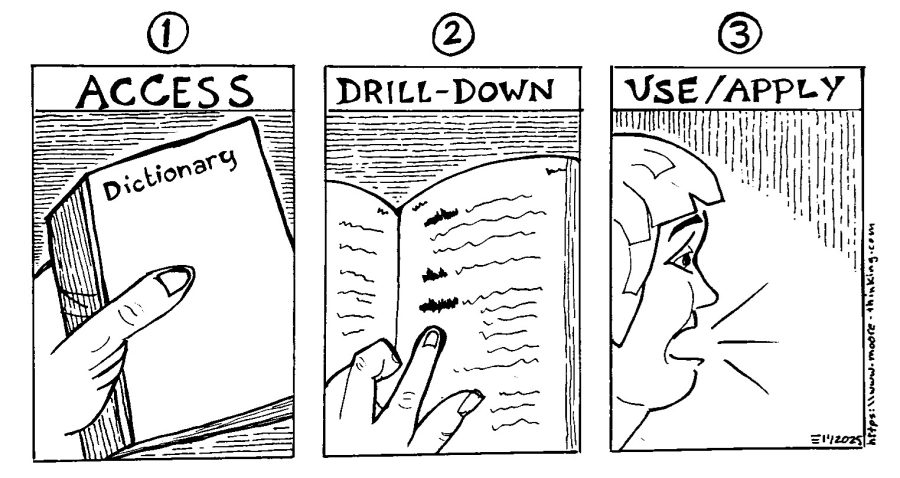
The fact is that there are three, and only three, reasons why people don’t benefit from instructional materials–and all of them are actionable.
1. Audiences can’t access the materials. This can happen when audiences:
- Don’t know the materials exist.
- Know they exist but can’t find them.
- Know the materials exist and can find them, but can’t access them (because, for example, the materials are password-protected).
2. Audiences can access the materials, but can’t figure out how to drill down to the specific resource they need. For example, audiences may be able to access a specific database, but not know how to get the search function to pull up the specific document, image, or video they’re looking for.
3. Audiences can locate the resources they’re looking for, but can’t understand or apply them. This failure occurs when resources are poorly designed, written, or laid out; missing definitions or steps; or authored for a different audience than the one trying to use or apply them.
How to address each of the 3 points of failure proactively
1. Identify the failure point(s). Identifying which of the three points of failure is preventing our audiences from taking advantage of our materials is critical because it allows us to fix the problem in the most efficient way possible and maximize our return on investment.
Site statistics (such as click-through rates) can only tell us so much. We’ll also need to talk with a representative subset of our audience and ask then if they’re aware of our materials. And we’ll want to sit with our audience as they attempt to access, drill down, use, and apply our materials, noting their reactions, collecting their feedback, and applying it as described below.
2. To address ACCESS failure:
- Document the availability of materials in a single, stable place, such as an online course catalog.
- Be sure the documentation lists the URL at which the instructional materials can be found and don’t change that URL.
- Make materials easy to access. If your project specifications dictate that materials must be password-protected or hidden behind a paywall, communicate that clearly and provide audiences an easy way at point of access to request credentials, register, pay, etc.
3. To address DRILL-DOWN failure:
- For materials delivered via database, provide both a robust search function (accompanied by search tips at point of search) and a skimmable link list structured by topic.
- To enable efficient drill-down within a resource, provide an at-a-glance structure: a table of contents for documents and interactives, timestamps/chapters for videos, and visible menus (in addition to a site map) for websites.
4.To address USE or APPLICATION failure:
- Spring for quality. Leverage skilled technical/marcomm/UI/UX writers, illustrators/graphic designers, web designers, and video producers who know how to apply best practices in their respective disciplines to create high-quality documents, images, videos, interactives, and websites.
- Ensure your content creators focus first, foremost, and always on relevance and fitness for purpose. Know your audience and present all the information they need (but no more) in a way that makes sense to them.
What’s YOUR take?
Has your team or organization experienced less-than-ideal rates of instructional material use or application? If so, which of the three points of failure were responsible? How did you identify and correct them—or are you still in the process of doing so? Please consider leaving a comment and sharing your hard-won experience with the learning community.
 Moore Thinking
Leave a comment